War has been raging in eastern Ukraine since 2014. In 2022, Russia expanded its war of aggression in eastern Ukraine and to other parts of the country. As early as summer 2021, we launched a pilot programme in conflict-affected communities along the then-contact line between Russia and regions in eastern Ukraine, where women for years have been affected by rampant poverty, social insecurity and gender-based violence. Our Ukraine programme gave them the space they needed to work together on strategies for safety and security in their daily lives and equal participation in peacebuilding. We continue building peace with them during the war.
In February 2022, we had just finalised an interview with our programme coordinator Olena Zinenko in Ukraine. Two days later, the Russian army attacked. As the second anniversary of the war of aggression approaches, Olena recalls her state of shock in those early days and months of the war and the journey she has taken since then. She also explains why talking about peace in Ukraine can create divisions and how women need to be the driving forces for a forward-looking “life agenda”.
Despite a growing awareness that the full, equal, safe and meaningful participation of women leads to more sustainable peace agreements, women remain largely excluded from formal peace negotiations. We strengthen women's participation in peace negotiations by finding creative ways to link formal and informal women's initiatives.
We have been working in Colombia since 2016 with our Peacebuilding After Armed Conflict programme. Since the signing of the peace agreement between the Colombian government and the FARC-EP guerrilla group, we have been advocating for the participation of women affected by the conflict in its implementation. In our Peacebuilding During Peace Negotiations programme, launched in 2025, we are also committed to ensuring that women participate in ongoing, locally rooted peace negotiations. Women and women's organisations must be equally represented at negotiations with local armed groups.
As part of a pilot programme in Sudan, we are connecting peace activists in the Dilling region in the south of Sudan with Sudanese activists who have lived in exile since 2023 due to the ongoing violence. Together with our local partner, we promote the targeted development of skills that these women can use to participate fully and meaningfully in peace negotiations and drive social change.
Together with our partners, we work to ensure that peace activists play an active role in implementing peace agreements as well as in processes of dealing with the past after armed conflicts – thereby contributing to the prevention of violent conflict and renewed escalation.
Transregional learning exchange in the Philippines
It was a unique exchange that we were able to organise with our partners in the Philippines in December: at various events, two representatives of the Gender Working Group of the Colombian Truth Commission exchanged their experiences with peace activists from the Philippines. Many moments of recognition and understanding emerged at during these exchanges. Our programme managers Andrea Filippi and Karin Widmer were there.
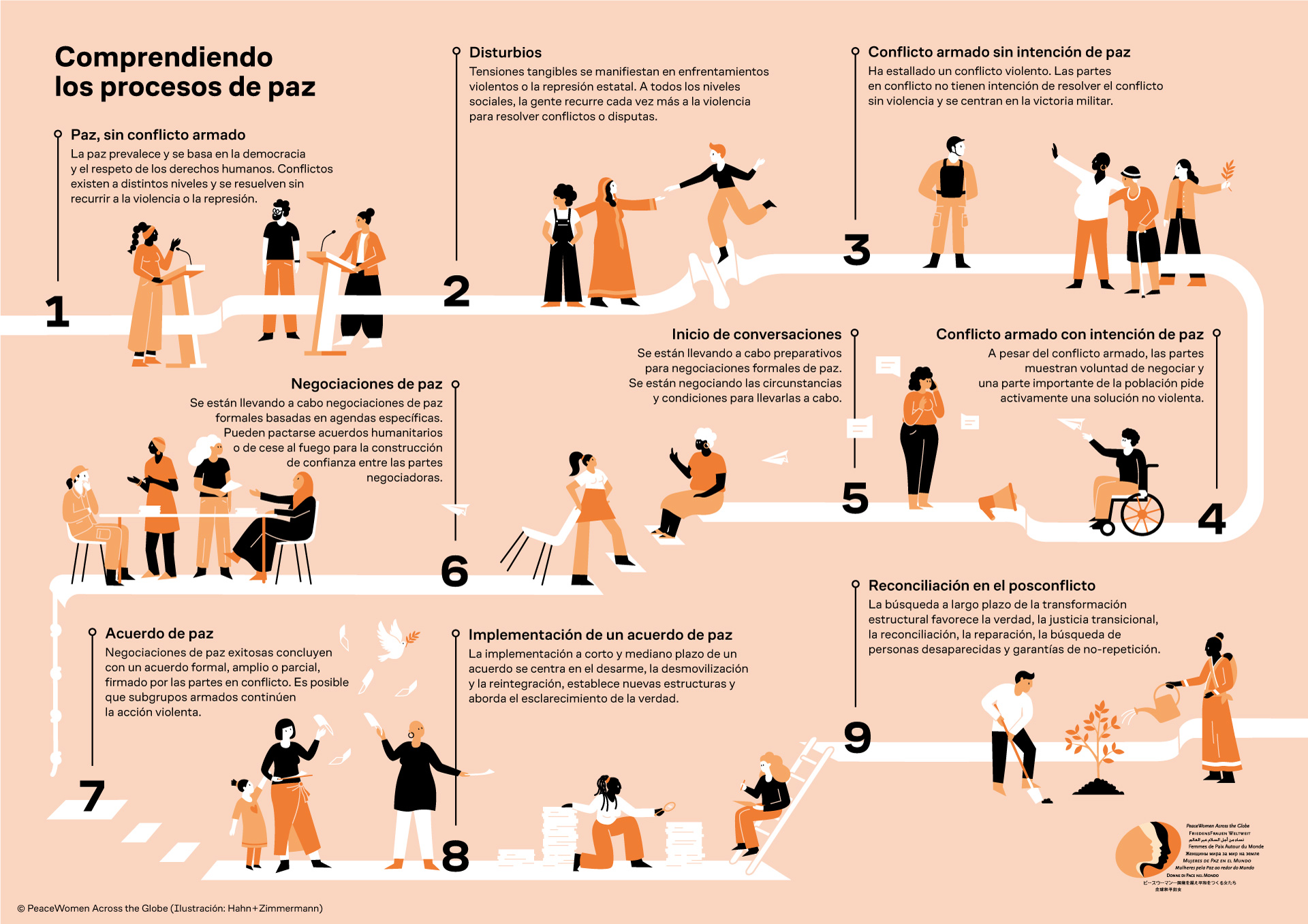
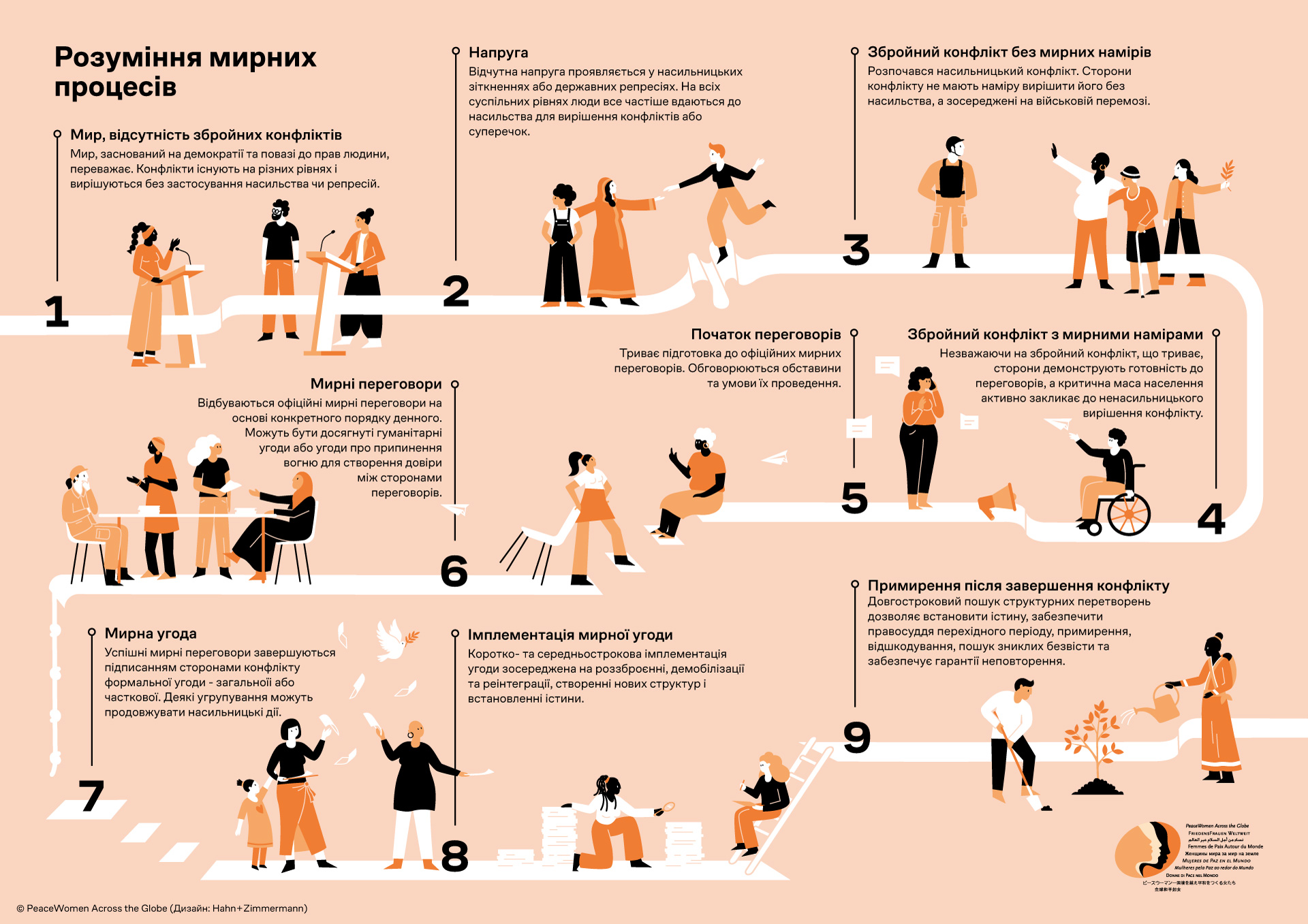
What images do the words "peace processes" evoke in your mind? Do you imagine years of negotiations culminating in a ceremony where the parties to the conflict sign an agreement, followed by a photo of the handshake that goes around the world? We have scrutinised and deconstructed this common image and taken an in-depth look at peace processes, as well as the question: "How do women influence peace processes?" The result of this work is a graphic representation of the different stages of peace processes. With this tool, we want to focus on the role women play and where they exert influence to drive peace processes and prevent setbacks.
Two workshops for 60 women peacebuilders directly affected by the armed conflict focused on strengthening their capacity to increase the visibility of their peace work and to advocate for their inclusion in peace processes. The workshops, organised by Badya Centre for Integrated Development Services, took place in Dilling, South Kordofan State, in southern Sudan in February 2025. We supported these workshops with our Feminist Peace Initiatives.
We are horrified by the recent escalation of violence in the Democratic Republic of Congo (DRC) and condemn the widespread attacks on the civilian population. We call upon all decision-makers in the region and the international community to respect International Humanitarian Law and human rights and to protect the civilian populations through all available means. In the meantime, we are making all efforts to support our network member in the DRC, who faces imminent danger.
We are horrified by the recent escalation of violence in Israel and Gaza and appalled by the loss of life. We condemn the violent attack by Hamas against the Israeli civilian population in the strongest terms. We also, decidedly, condemn the violence used by Israeli Forces against the Palestinian civilian population. Together with civil society and peace organisations in Israel and Palestine, we call upon all decision-makers there to respect International Humanitarian Law (IHL) and human rights and to protect the civilian populations through all available means. This includes, among others, an immediate end to Hamas’ hostage-taking of civilians and to the blockade of Gaza imposed by the Israeli government, cutting the population off, especially from access to water, food, electricity and fuel.
Following the adoption of two bills by Israel’s parliament on 28 October 2024, UNRWA is threatened with having to cease its operations (humanitarian, medical and educational) in the West Bank and Gaza by the end of the year. At a time when the conflict in Gaza has already claimed tens of thousands of victims, no other humanitarian organisation or authority can take on UNRWA's tasks in Gaza. Hindering the agency's work jeopardises the entire aid operation for Palestinian victims in Gaza, as all other organisations (UN and international and national NGOs) use UNRWA's logistical and administrative systems.
Militarisation means more than "just" spending on armed forces: this spending is the consequence of a security policy geared towards war. As a feminist peace organisation, we oppose the claim that more weapons lead to more security. We demand demilitarisation and disarmament because that is the only way to achieve genuine peace and comprehensive security.
Caryn Dasah (left in the picture), a peace activist from our global network Feminists Connecting for Peace, is campaigning for peace and social justice in a country that is experiencing a globally neglected armed conflict: the Anglophone crisis in Cameroon. In this interview, she talks about the risks that young people like her take in their commitment to peace and justice.
Since April 2023, Sudan has been embroiled in a brutal conflict between the Sudanese Armed Forces and the Rapid Support Forces. As a result, tens of thousands of people have been killed, twelve million have been displaced, and famine is imminent. On 24 July 2024, the United States invited the Sudanese Armed Forces and the Rapid Support Forces to peace talks in Switzerland to take place on 14 August. So far, similar initiatives to bring about a ceasefire have failed. Prominent Sudanese mediator and peace activist Rabab Baldo is part of our global network Feminists Connecting for Peace. She has decades of experience working for a just peace in Sudan and explains what needs to happen for the talks in Switzerland to succeed.